


What are the Botox Application Areas? Which Areas Is Botox Applied?

Highlights
- Botox is applied to the upper face—specifically the forehead, between the eyebrows, and around the eyes.
- The lower face, masseter, and neck region are the primary treatment areas.
- The dosing approach varies by region; the natural outcome depends on this balance.
- The article discusses lesser-known applications and the selection of regions based on age.
Percentage Botox Regions and Areas of Effect
Over the years, when we smile, get angry or surprised, our facial muscles start to leave permanent scars on our skin. The most effective way to stop these scars is to calm the excessive mobility of those muscles. Although most of us associate Botox with the upper face area, in the medical world botox application areas much wider.
Botox can be used in almost every area of facial anatomy. In fact, it has a role in improving the quality of life not only for aesthetic purposes but also for functional problems such as teeth clenching and excessive sweating.
The dosage and effect of Botox vary depending on the area. When applied to the upper lip in a small dose, lip Botox (lip flip), and at the tip of the nose nose Botox It reduces the drooping of the mouth. In cases of asymmetrical facial expressions caused by muscle imbalance Can facial asymmetry be corrected with Botox? The answer to this question lies, once again, in regional dosing. In cases of teeth grinding in the jaw area, The Role of Botox in the Treatment of Bruxism Another area of application is in headaches caused by muscle tension, where The Use of Botox in Migraine Treatment It comes up for discussion.
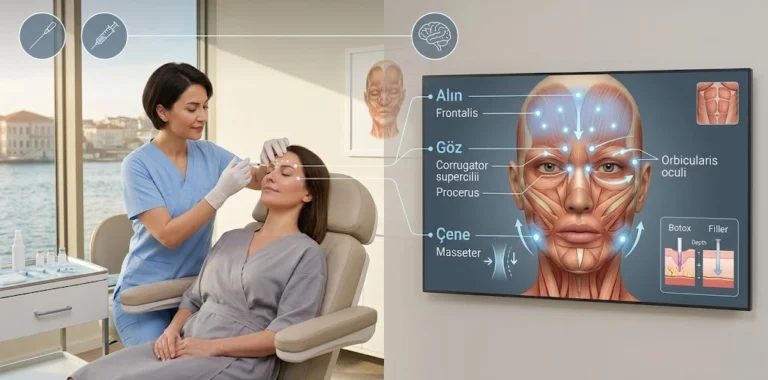
Forehead Botox and Eye Contour Botox: Upper Face Applications
The upper part of our face is the area where we use facial expressions the most and where the first signs of aging begin to appear. That’s why the most popular procedures are Get Botox and Botox for the eye area is administered here.
- Forehead lines Corrects horizontal lines formed by a surprised expression. It is very important to maintain a natural smoothness without lowering the eyebrows.
- Between the eyebrows (glabella): It softens the vertical lines that make you look “angry” (the lion line) and gives the face a more rested expression.
- Goose feet These are the lines that open like a fan at the edge of the eye when we laugh. With eye contour botox, these wrinkles are softened and the look brightens.
Details about the general botox mechanism what is botox you can find in my article.
Masseter Botox Regions and Lower Face Applications
The days when Botox was limited to the eye area are long gone. With techniques applied to the lower face, we can even contour the face. Masseter Botox These regions are the areas where we work most frequently.
- Masseter (chin) botox: It is an effective solution for those with teeth clenching and grinding (bruxism). Relaxes the overdeveloped chewing muscle and slims the appearance of a square jaw. For details masseter botox you can read my article.
- Upper lip (barcode) lines: It is used to lighten the vertical lines on the lips of smokers or those who mimic frequently.
- Gummy smile (gummy smile): It is a tiny touch that prevents the gums from showing too much while laughing.
- Chin tip (orange peel): It provides a smoother line by correcting the rough appearance at the tip of the chin.
Neck Botox and Nefertiti Lift
Neck Botox, a procedure that complements facial rejuvenation but is often overlooked. “Nefertiti Lift”In this technique, known as “,” the vertical bands of muscle (platysma) extending from the neck to the jawline are loosened.
As the band tension decreases, the jawline appears more defined and the sagging sensation in the jowl area softens. When planned together with the face, neck botox provides a holistic and balanced rejuvenation.
Which Areas Botox is Applied to: Table Summary
| Region Name | Problem Treated |
|---|---|
| Forehead Area | Horizontal mimic wrinkles |
| Between Eyebrows | Vertical “anger” lines |
| Eye Contour | Crow's feet wrinkles |
| Nose (Bunny Lines) | Rabbit lines on the back of the nose when laughing |
| Jaw (Masseter) | Tooth clenching, square jaw width |
| Lip Contour | Barcode lines, gummy smile |
| Neck (Nefertiti) | Neck bands (platysma) and double chin sagging |
Botox Application Regions and Region-Specific Dose Approach
Each area requires a different balance, so the dose and technique varies according to the area. On the upper face, our goal is to soften the line but preserve the brow movement. On the lower face and chin, the goal is usually thinning and relaxation.
Scientific foundations of the regional approach American Academy of Dermatology You can also examine them from their sources. The right map is a prerequisite for a result that preserves natural expression.
In our clinic, we first analyze your facial anatomy and then plan individual doses for each area. This personalized approach provides a rested look, not like a mask. If you are curious about the post-procedure process things to consider after botox my guide will help you.
Let's Create Your Appointment Now
Leave your name and phone number and we will call you to discuss the right treatment and an appointment time.
Reach us by phone+90 532 336 52 00The Secret to a Natural Look in Botox Areas
The natural result starts with knowing which area to leave untouched and how much. Instead of stopping every muscle completely, we prefer to preserve the expressive movements. This is why sometimes a small dose is more successful than a large dose.
The balance between the regions is as important as the dose. While relaxing the forehead, the harmony of the neighboring muscles is observed so that the eyebrows do not fall. This fine-tuning reveals a rested face that does not say “botoxed”.
In our clinic, we plan each area separately, but we read the face as a whole. Your facial expressions are your signature; refreshing them without erasing them is our priority.
Less Known Botox Application Areas
When it comes to Botox, the forehead and eye area usually come to mind; however, the application area is much wider. Armpit and palm applications significantly increase comfort in clients with excessive sweating. In the problem of teeth clenching, the application to the jaw muscle reduces both pain and facial squaring.
These applications require expertise; targeting the right muscle at the right dose is the key to the result. Each new area requires a separate knowledge of anatomy, so we plan each area with the same meticulousness and individualization.
Regardless of the area, the first step is always a detailed facial analysis. The dose applied without correctly reading the strength of the muscles and their relationship with each other can lead to undesirable results. That's why we start by evaluating the whole face, not the area; natural results are only possible with this holistic view.
At what age is Botox suitable for which area?
Botox application areas also differ according to age. In the late twenties and early thirties, low doses are generally preferred for protective purposes, in areas with intense facial expressions such as between the eyebrows and forehead. The aim here is to intervene before the lines leave permanent scars.
From the mid-thirties onwards, as the lines around the eyes and forehead become more prominent, these areas become prominent. In advanced ages, instead of Botox alone, holistic plans that support the neck and jaw line give more accurate results.
So the answer to the question “which area” depends not only on the wrinkle, but also on age and skin structure. The right timing is as important as the right area and we will evaluate this together.
Most Common Mistakes in Region Selection
The most common mistake I see is to focus on one area and not see the face as a whole. Relaxing only the forehead can make the eyebrows look low, because the neighboring muscles balance together. So when we plan an area, we always take into account the surrounding muscles.
Another mistake is the misconception of “the more areas, the younger appearance”. However, success in botox is hidden in the correct selection of the dose and region; intervention in more areas than necessary may disrupt the naturalness. Less but appropriate application often gives the most elegant result.
Finally, wrong area expectation is also common. The deep grooves that are fixed are the area of filler, not Botox. We clarify this distinction in the examination and direct you to the application you really need. Our goal is always a safe, measured and good-looking result.
Are the Persistence Periods of Different Regions the Same?
How Long Does Botox Last? It varies by area, because the strength and frequency of use differ for each muscle. In areas with fine muscles, such as the forehead and around the eyes, the effects generally last four to six months. In contrast, in a very strong area like the chewing muscles, the results may be slightly shorter-lasting after the first few treatments.
Interestingly, with regular practice, the duration lengthens regardless of the area. As the muscles learn to “contract less”, the session intervals naturally increase. In other words, as you treat the same area regularly, you will need fewer appointments over time.
That's why it would be inaccurate to express permanence only in a single number. We evaluate the area, your muscle strength and your lifestyle together and give you a realistic timetable. This way, we can clearly plan which area you will need and how often you will need it.
Application
Botox Treatment
You can have this procedure done at Dr. Melis Ülger’s office in Kadıköy Caddebostan.
Frequently Asked Questions
Can Botox be applied to every wrinkle on the face?
No, it does not. Botox only affects dynamic wrinkles due to muscle movement (mimics). Filling applications are necessary for collapses and deep grooves (for example, nasolabial lines on the side of the nose) that exist on your face while standing still.
Does Botox eliminate bags under the eyes?
No, Botox does not affect under-eye bags or bruises. For these problems, different medical aesthetic methods such as light filling or mesotherapy should be preferred.
Is botox applied to the neck area?
It is definitely done. With this technique called “Nefertiti Lift”, the vertical muscle bands extending from our neck to our jawline are loosened. Thus, the jaw line becomes clearer and the neck gets a younger appearance.
Is Botox snake venom?
No, it has nothing to do with snake venom. Botox is a medical protein that has been purified in the laboratory and safely applied millions of times around the world.
What should be considered after Botox?
Stay upright for the first four hours and avoid heavy exercise, alcohol and massaging the area. These simple rules ensure a safe outcome.
When does Botox take effect?
The result is first noticeable around the third day. The full effect occurs within 10-14 days.

You may also like
-
What to Do If Swelling After Botox Doesn’t Go Away
How long does swelling after Botox last, and which signs call for a doctor? Learn the difference between normal edema and persistent swelling, and book from Caddebostan. -
Botox Reviews: Real Patient Experiences
How do Botox patients describe the process? First-session expectations, concerns about looking natural and frequently asked questions from Dr. Melis Ülger’s clinic. -
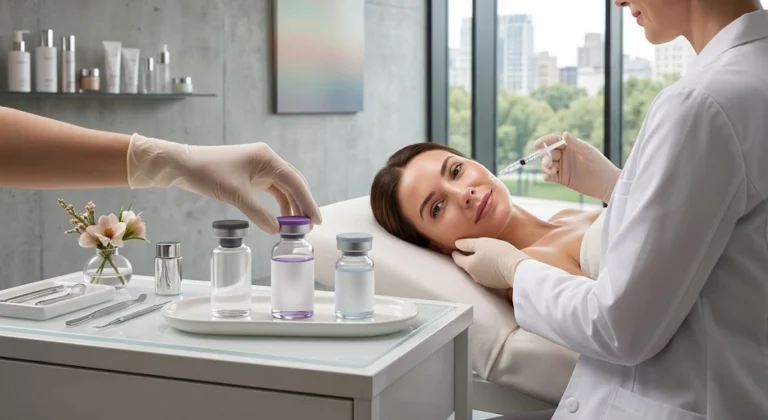
Botox Brands: The Difference Between Botox, Dysport, and Xeomin
Botox Brands: What’s the difference between Botox, Dysport, and Xeomin? Dr. Melis Ülger explains the active ingredient, unit dosage, and onset of action.
 Türkçe
 English