










Can a Home Skin Care Device Replace a Clinical Device?
25/09/2026
How to Choose a Mesotherapy Cocktail? Personalized Planning
30/09/2026Choosing Active Ingredients for Skincare: What Does Each One Do?
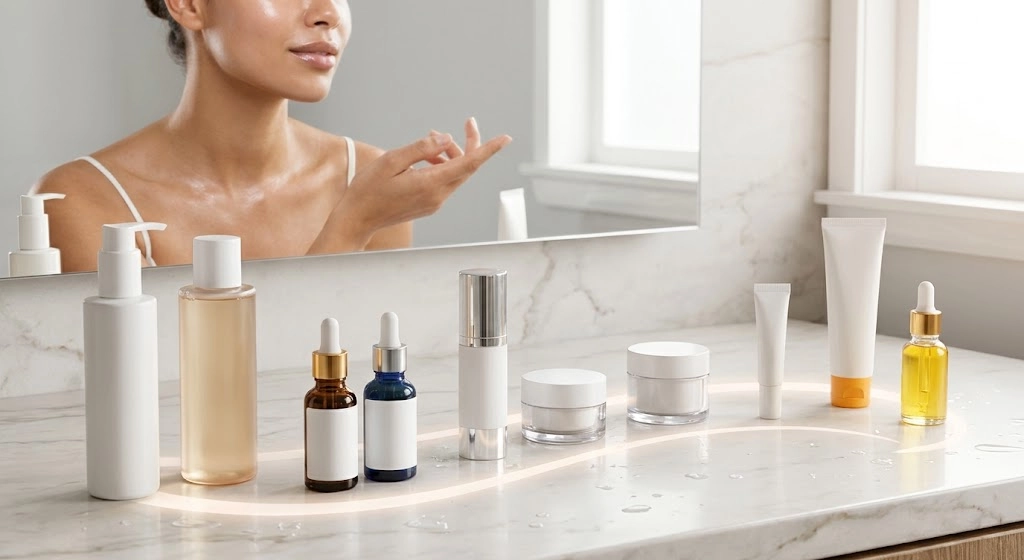
My clients usually come to me with just one question: Which cream should I buy? Instead of naming specific brands, I prefer to teach them how to read labels, because anyone who knows how to identify the right ingredients can find a product that works for them, no matter their budget. In skincare, an active ingredient is the key component that actually delivers the effect a product claims to provide.
In this article, we’re talking about what’s inside the jar: what each active ingredient does, who it’s suitable for, and where it falls short. The order in which you apply the products is a separate topic; we’ll cover that Skincare Routine I explained it step by step in my article.
Highlights
- An active ingredient in skincare is the active component that produces the effect promised by a product; it is this component—not the brand name—that determines the result.
- Hyaluronic acid and glycerin attract moisture, while ceramides and niacinamide support the skin barrier, and retinoids accelerate cell renewal.
- Görünür cilt yaşlanmasının büyük bölümü güneşe bağlıdır; Amerikan Dermatoloji Akademisi bu payı yaklaşık %90 olarak veriyor.
- The list of ingredients is written in descending order; that is, if the promised ingredient is at the end of the list, the amount may be nominal.
- Applying retinol and acids one after another on the same evening is the most common mistake I come across, and it strains the skin barrier.
Why Is the Active Ingredient in Skincare So Crucial?
A product’s price, packaging, and scent do not affect the results; it is the active ingredient in the formula that does the work. Two products containing the same active ingredient will produce similar results, while two products with different active ingredients will yield different results, even if they sit on the same shelf.
That’s why, during our first sessions, I ask my clients to bring in the products they’re using. More often than not, the problem isn’t the quality of the product, but rather a mismatch between the active ingredient and the skin’s needs. For example, a heavy repair cream might be prescribed for oily skin, or three different acids might be recommended for skin prone to irritation.
Moisturizers: Hyaluronic Acid Cream and Glycerin
Hyaluronic acid is a molecule that can hold far more water than its own weight. It draws moisture into the skin and gives it a plump appearance. Glycerin serves a similar purpose and is generally more economical.
An important detail: these ingredients attract moisture but do not retain it. If a barrier-supporting product isn’t applied over a hyaluronic acid cream or serum, the skin may lose moisture in a dry environment. In other words, a serum alone is often not enough.
Barrier Restorers: Ceramide and Niacinamide
Ceramides are natural lipids found in the skin’s structure; think of them as the mortar between the bricks of the skin barrier. They are beneficial for skin with a weakened barrier that is prone to redness and irritation.
Niacinamide, on the other hand, is a versatile derivative of vitamin B3. It is reported to have effects on pore appearance, uneven skin tone, and oil balance. It is well-tolerated by most skin types, making it a safe choice for beginners.
What Is Retinol, and How Do You Get Started?
The short answer to the question “What is retinol?” is this: it is a vitamin A derivative that accelerates cell renewal. It is used to treat fine lines, the appearance of pores, and acne-prone skin. It is the most common member of the retinoid family and is available in lower concentrations in over-the-counter formulations.
This is a potent treatment, so it’s important to start slowly. The right approach is to begin with two nights a week and increase the frequency based on how your skin reacts; dryness and mild flaking may occur during the first few weeks. Retinoids should not be used during pregnancy or while breastfeeding; if you have any concerns, consult your doctor.
Retinoids are part of a home care regimen for dark marks left by acne, but they are not sufficient on their own for deep scars. The clinical aspect acne scar treatment I also addressed this in my article.
Nutrients: Vitamin C and Others
Vitamin C acts as both an antioxidant and a brightening agent. Since it helps protect against free radical damage throughout the day, it has a place in your morning routine. Because it can degrade when exposed to light and air, it’s best to choose products in dark, airtight packaging.
It may not be sufficient on its own for dark spots; noticeable results usually come from a combination of treatments. The differences between types of dark spots and the rationale behind their treatment How to Get Rid of Skin Spots I explained it in my article.
Acids: AHA and BHA
The AHA group (glycolic and lactic acids) is water-soluble and removes dead skin cells from the surface; it is suitable for dull and rough skin.
BHA, or salicylic acid, is oil-soluble, so it can penetrate the pores. It is recommended for blackheads and oily skin. Using both on the same night is generally unnecessary and increases the risk of irritation.
The superficial rejuvenation achieved by acids, which we perform at our clinic, hydrafacial These are considered the domestic equivalents of such transactions. Neither can take the place of the other; the two complement each other.
Contact us
Create Your Appointment
Which Active Ingredient Is Right for Whom?
The table below summarizes the seven components I most frequently discuss with my clients. The combination that’s right for you will become clear after an in-person skin analysis; the table provides only a general overview.
| Active Ingredient | What Does It Do? | Who Is It For? | Point to Note |
|---|---|---|---|
| Hyaluronic Acid | Absorbs moisture and gives a plump appearance | Skin prone to dryness and dullness | You need to apply a barrier cream on top |
| Ceramide | Fills in the gaps in the barrier | Skin prone to redness and irritation | The effects become noticeable with regular use |
| Niacinamide | Helps maintain a healthy balance of muscle and fat | Beginner level, suitable for most skin types | It can cause significant redness |
| Retinol | Accelerates cell regeneration | Fine lines, pores, acne-prone skin | Do not use during pregnancy; start with a low dose |
| Vitamin C | Antioxidant support and brightening | Dull complexion, sun-damaged skin | May deteriorate when exposed to light and air |
| AHA (Glycolic) | It loosens dead skin cells on the surface | Rough texture and dullness | Increases sensitivity to sunlight |
| BHA (Salicylic Acid) | Dissolves oil inside the pore | Blackheads and Oily Skin | May cause irritation on dry skin |
Sunscreen: The Only Surface Where Active Ingredients Can Work
None of the above measures will produce the expected results without consistent sun protection. Since most visible signs of aging are caused by cumulative UV exposure, sun protection is not an add-on but a foundation. American Academy of Dermatology bu payı yaklaşık %90 olarak bildiriyor.
Aynı kurumun verisine göre SPF 30 ve üzeri bir ürün, UVB ışınlarının yaklaşık %97’sini süzer. Geniş spektrumlu bir ürün seçmek ve gün içinde yenilemek, yüksek faktör seçmek kadar belirleyicidir.
In people who use retinol and acids, the skin becomes more sensitive to the sun. In this case, sun protection is no longer an optional step but becomes as integral to the skincare routine as the active ingredient itself.
Concentration: “Contains” Is Not Enough
The fact that the name of an ingredient appears on a product's label does not mean that the product contains that ingredient in an effective amount.
The list of ingredients is written in descending order. If a promised active ingredient appears near the bottom of the list, it likely contains only a trace amount. Some manufacturers specify the percentage on the packaging; if it isn’t specified and the ingredient is at the end of the list, it’s best to exercise caution.
Another practical tip: “All-in-one” products that contain a large number of active ingredients at once usually don’t contain enough of any of them. Simple formulas often work better.
Which Ingredients Should Not Be Used Together?
Some combinations reduce the effectiveness of one another or increase the risk of irritation.
Using retinol and AHA/BHA acids on the same night is the most common mistake; both accelerate skin renewal, and when used together, they can damage the skin barrier. Retinol and benzoyl peroxide are also not recommended for simultaneous use. There used to be some concern about combining vitamin C and niacinamide, but in today’s formulations, these two can generally be used together without any issues.
For sensitive and irritation-prone skin, it’s helpful to stagger the use of active ingredients over several days. Alternating between a retinoid one night and a restorative treatment the next night yields the same results with less strain on the skin.
How Long Should I Wait for Results?
The duration varies depending on the active ingredients, and realistic expectations prevent disappointment.
Moisturizers make a difference within days. Ingredients like niacinamide take a few weeks to show results. With retinol, the first noticeable changes usually take two to three months; the dryness and flaking in the first few weeks are part of the adjustment process, not the result. Treating dark spots takes the longest and is directly dependent on sun protection.
The easiest way to track the passage of time is through photographs. Photos taken once a month under the same lighting conditions provide a more reliable measure than the daily fluctuations of a mirror.
How Do You Choose a Skincare Product?
Choosing a skincare product comes down to three questions: What does my skin need right now? Which active ingredient addresses that need? And is that active ingredient present in sufficient amounts in this product?
The distinction between a pharmacy and a cosmetics aisle isn’t as clear-cut as one might think. What matters isn’t where the product is sold, but the ingredients and their proportions in the formula. Dermocosmetic products sold in pharmacies generally have simpler formulas and contain less fragrance, which is an advantage for those with sensitive skin. However, not every pharmacy product is automatically more effective.
Price alone is not necessarily an indicator of quality. Of two products containing the same amount of the same active ingredient, the more expensive one often differs only in its texture and scent.
How Do You Get Started with a New Asset?
Add one product at a time and use it for at least two weeks. If you start using three new products in the same week, you won’t be able to tell which one is causing any problems.
When trying a new product, first test it on a small area along the jawline for a few days. If you experience a burning sensation, persistent redness, or itching, stop using it. You may feel a slight tingling sensation in the first few days, but a bothersome reaction is a clear warning sign from your skin.
If you are pregnant, breastfeeding, or have a known skin condition, do not choose an active ingredient on your own. Which ingredient is appropriate in these cases varies from person to person and requires a doctor’s evaluation.
Dr. Melis Ülger reads the labels together with her clients at her practice in Caddebostan; rather than completely replacing the products they’re using, she prefers to keep what works and add what’s missing. If you’d like to discuss whether the products you’re using are suitable for your skin, Communication You can schedule an appointment on that page. Remember, you’re buying the list behind the jar, not the jar itself.
Last updated: September 28, 2026
This content has been reviewed by Dr. Melis Ülger, a medical aesthetics specialist. Dr. Melis Ülger is a medical aesthetics specialist who matches the active ingredients in skincare products to her clients’ skin types and tolerance levels.
Frequently Asked Questions
How do I know if the active ingredient on the label is sufficient?
The list of ingredients is written in descending order; that is, the ingredients listed first are present in the highest amounts in the product. If a promised active ingredient appears toward the end of the list, its amount is most likely only symbolic. Products that list the percentage on the packaging are more transparent in this regard.
Is hyaluronic acid alone enough?
Generally, no. Hyaluronic acid attracts moisture but doesn’t retain it on the surface; if a barrier-supporting product isn’t applied on top, the skin may lose moisture in a dry environment. It works best when layered with a moisturizing cream.
Who is niacinamide suitable for?
Since it is well-tolerated by most skin types, it’s a good starting point for those who want to try active ingredients. It’s reported to have an effect on the appearance of pores, uneven skin tone, and oil balance. At very high concentrations, it may cause redness in sensitive skin.
What should I keep in mind when using retinol?
The recommended approach is to start with two nights a week and increase the frequency based on your skin’s reaction. Dryness and mild flaking may occur during the first few weeks; this is part of the adjustment period. Do not use during pregnancy or while breastfeeding; consult your doctor if you have a chronic skin condition.
What is the difference between AHA and BHA?
AHA is water-soluble and removes dead skin cells from the surface; it is recommended for dull and rough skin. Since BHA is oil-soluble, it can penetrate into the pores and is effective against blackheads. Using both on the same night is generally unnecessary.
Is an expensive product more effective?
Price alone does not indicate effectiveness. Of two products containing the same active ingredient in similar proportions, the more expensive one usually stands out for its texture, scent, and packaging. It is better to compare products based on their ingredient lists rather than their brands.

Appointment & Contact
Contact our clinic for reliable and personalized planning in medical aesthetic applications.
Write to Us
Let's Create Your Appointment Now
Related Articles

 English