












Mesotherapy Needles: Gauge, Depth, and Pain Sensation
21/09/2026
Can a Home Skin Care Device Replace a Clinical Device?
25/09/2026Skincare Routine: In What Order Should You Apply Products?
Most of my clients end up buying the right products but use them in the wrong order. The proper skincare sequence is to apply products in order of consistency, from the thinnest to the thickest. Using them in the wrong order renders an expensive serum ineffective, turns the moisturizer into an oily film on the skin, and makes the sunscreen clumpy.
It takes five minutes to learn this routine. Below, I’ll walk you through the morning and evening steps, the differences based on skin type, and the most common mistakes I see, in that order.
Highlights
- The order of a skincare routine can be summarized with a single rule: apply the lightest product first and the thickest product last.
- Sunscreen is the final step in your morning routine; no other skincare product is applied on top of it.
- Amerikan Dermatoloji Akademisi’ne göre SPF 30 ve üzeri bir güneş koruyucu, UVB ışınlarının yaklaşık %97’sini süzer.
- Apply vitamin C in the morning and retinol in the evening; applying both at the same time increases the risk of irritation.
- A trio of cleanser, moisturizer, and sunscreen provides a sufficient foundation for most skin types.
How Do You Set Up a Skincare Routine?
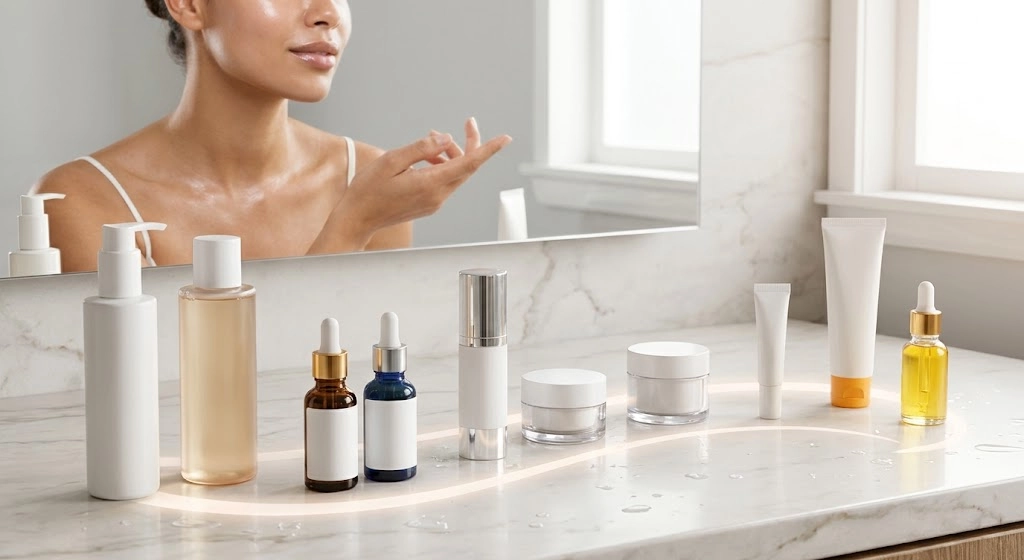
The skincare routine is organized based on the consistency of the products. The wateriest product is applied first, the thickest last; every product in between is placed in its proper order according to this hierarchy.
The reason is simple. A thick product forms a thin layer on the skin. A water-based serum applied afterward cannot penetrate that layer and reach the skin. In other words, simply by changing the order of application, you can render your most effective product ineffective.
Order of the Morning Skincare Routine
The purpose of a morning routine is to protect the skin: to prepare it for the day and shield it from the elements it will encounter throughout the day.
– Cleaner: It removes the sebum that has built up overnight. If your skin is dry, just water may be enough in the morning. – Tonic: If you're using it, apply it immediately after cleansing, while your skin is still damp. – Serum (antioxidant): Antioxidants like vitamin C are a staple of your morning routine; they help protect against free radical damage throughout the day. – Eye cream: Since the skin around the eyes is delicate, this is a separate step. – Moisturizer: Locks in the serum's effects. – Sunscreen: Always the final step. It comes after all the other steps in the routine.
Order of the Evening Skincare Routine
The purpose of the evening routine is to repair the skin. The skin renews itself at night; that’s why active ingredients are used in the evening.
– Makeup remover: If you're wearing makeup, you need to double-cleanse; first, use an oil-based product to remove the makeup. – Cleaner: Then a regular cleanser. – Active product: Retinol, acids, or therapeutic products come into play at this stage. – Moisturizing/repairing cream: Finally, it supports the barrier.
Why the skin barrier is so crucial medical skin care I explained it in my article.
| My name is | Morning Routine | Evening Routine | The reason it happened at that time |
|---|---|---|---|
| 1 | Cleaner | Oil-based makeup remover | No product can penetrate the skin unless surface dirt and sebum are removed first |
| 2 | Tonic (optional) | Cleaner | Clean twice in the evening; once in the morning is enough |
| 3 | Antioxidant serum | Active ingredient (retinol or acid) | The most hydrating products are those that come into direct contact with the skin |
| 4 | Eye cream | Eye cream | Since the skin around the eyes is thinner, it requires its own product |
| 5 | Moisturizer | Repairing cream | It slows down the evaporation of the thin layers beneath it |
| 6 | Sunscreen | None | If the protection layer isn't at the top, it can't do its job |
Why Is Sunscreen Applied Last?
Sunscreen is not a skincare product; it is a protective layer. To be effective, it must sit on top of everything else on the skin, not on the skin itself. Applying a moisturizer on top of it dilutes and disperses the filter.
The importance of this step is also evident in the numbers. American Academy of Dermatology‘ne göre SPF 30 ve üzeri geniş spektrumlu bir ürün, UVB ışınlarının yaklaşık %97’sini süzer. Rutininizdeki en pahalı serum bile bu korumanın yerini tutmaz.
This step should not be skipped even during the winter months or on cloudy days. Even a single workday spent indoors can result in UV exposure.
Do not use active content at the same time
This is the mistake I see most often. Retinol, vitamin C, and AHA/BHA acids are potent ingredients; applying them all one after another on the same night won’t repair your skin—it will irritate it.
A practical approach: Take vitamin C in the morning and retinol in the evening. If you’re using an acid, don’t use it on the same evening as retinol; alternate their use every other day. If you experience redness, a burning sensation, or flaking, take a break; this is a clear signal from your skin.
Which pieces of content serve a purpose and which ones don't go together skin care active ingredient I covered each one individually in my guide.
Why does waiting between skincare steps work?
Waiting one minute after each step is usually sufficient. The goal is not to allow the product to be fully absorbed, but to prevent the layers applied on top of each other from clumping together.
This is a bit more important with sunscreen. If you apply sunscreen right after moisturizer, it may become grainy and not spread evenly on the skin. Waiting a short while will solve this.
Fewer products, in the right order
You don’t have to follow an eight-step routine. A cleanser, moisturizer, and sunscreen provide a sufficient foundation for most skin types.
Add active products one by one; don’t start using them all at once. That way, if a problem arises, you’ll know which product caused it. My male clients often ask: the order of a skincare routine doesn’t change based on gender; the only things that differ are the product’s texture and post-shave sensitivity.
Contact us
Create Your Appointment
Does the Skincare Routine Vary Depending on Skin Type?
The order of the skincare routine remains the same, but the number of steps and the consistency of the products vary. The principle remains the same: the products used are chosen based on the skin’s needs.
For oily skin, light, water-based products are preferred, and the moisturizer step can be a gel. Skipping the moisturizer is a common mistake, because dry skin produces more oil. For dry skin, however, the moisturizing layer is made thicker; if necessary, a second reparative cream is applied over the serum.
A targeted approach works well for combination skin. You can apply a lighter product to the T-zone and a richer one to the cheeks. For sensitive skin, the safest approach is to minimize the number of steps, use active ingredients sparingly, and test each new product on its own.
Morning or Evening? When to Use Which Product
Some content performs better at certain times of the day, and this isn’t just a matter of personal preference.
Antioxidants like vitamin C are best used in the morning because their role is to protect against free radical damage encountered throughout the day. Retinol and acids are best used in the evening: not only does the skin’s nighttime repair process align with how these ingredients work, but these substances also make the skin more sensitive to the sun. Moisturizers and sunscreen, on the other hand, remain effective at any time of day.
What Should You Expect as You Transition to a New Routine?
It takes time for your skin to adjust to a new routine. You may experience mild dryness or minor breakouts during the first two weeks; this is usually a temporary adjustment period.
Patience is truly essential here. The American Academy of Dermatology notes that it can take up to 12 weeks to see noticeable results from over-the-counter retinol products. If you decide after three weeks that “it didn’t work” and switch products, you’re constantly subjecting your skin to a new adjustment period.
However, a burning sensation, persistent redness, and itching are not signs of your skin adjusting to the products; they are signs of irritation. In such a case, instead of discontinuing your entire routine, remove the product you added most recently and stick to a simple routine for a few days. If the problem goes away, that means you’ve identified the cause.
Another Factor That Affects the Ranking: Quantity
Applying it in the correct order but in the wrong amount will also ruin the result. A few drops of serum are enough; any more will remain on the surface without being absorbed and prevent the next product from adhering properly.
With sunscreen, however, the opposite is true: most people use less than they should. For the face, about two finger-lengths of product is recommended. If you don’t apply enough sunscreen, it won’t provide the sun protection factor listed on the label.
Common Habits That Disrupt the Order
The three habits I correct most often at my clinic are: applying sunscreen before moisturizer, using micellar water instead of toner without rinsing it off, and applying a new product directly to the entire face.
When starting a new active ingredient, first test it on a small area along the jawline for a few days. If your skin doesn’t react, apply it to your entire face. This simple step protects you from weeks of skin irritation.
How Does Clinical Care Fit into the Home Routine?
A treatment performed at the clinic does not replace your at-home routine; it complements it. Deep cleansing and hydration are provided in a single session at the clinic; whether this effect lasts for weeks depends on your at-home routine.
On the day of the treatment, the routine is simplified. Do not use any active products the evening after the treatment; a cleanser, a restorative moisturizer, and sunscreen the next morning are sufficient. Water-based vacuum-powered hydrafacial skin care With methods like these, the skin can return to its normal routine the very next day; with acid-based or needle-based treatments, this period is longer.
It’s also a good idea to do a little preparation a few days before the session. Taking a two- or three-day break from strong acids and retinol helps your skin respond more evenly to the treatment.
Does the order change after the transaction?
It varies. After treatments such as mesotherapy, gold needle therapy, or chemical peels, the skin barrier becomes temporarily more sensitive.
During this period, active ingredients should be paused; a simple cleanser, a restorative moisturizer, and sunscreen are sufficient. The treating physician will determine when to resume use; follow your own plan rather than a general rule.
We can determine which steps are truly necessary for your skin by reviewing the products you use together. If you’d like to see which treatment at the clinic would fit into your routine, hydrafacial You can check out my page to discuss your own routine Communication You can message me from that page. The correct order is the same for everyone, but the correct product is different for everyone.
Dr. Melis Ülger, Medical Aesthetics Specialist. At her practice in Caddebostan, she designs her clients’ home care routines in conjunction with their clinical treatment plans.
This content has been reviewed by Dr. Melis Ülger, a Medical Aesthetics Specialist.
Frequently Asked Questions
In what order should skincare products be applied?
The basic rule is to apply products from thinnest to thickest. The lightest, most watery product goes on first, and the thickest product goes on last; sunscreen is always the final step.
Should I apply the serum or the moisturizer first?
Apply the serum first. Serums have a lighter texture and are designed to penetrate the skin; applying moisturizer on top helps lock in this effect.
Can I use vitamin C and retinol together?
Using them at the same time can cause irritation. A practical approach is to use vitamin C in the morning and retinol in the evening.
How many steps should the routine include?
Three steps are enough for most skin types: cleansing, moisturizing, and sun protection. Active ingredients are added to this foundation one at a time, with a few weeks in between.
Should you apply sunscreen before or after makeup?
Skincare products should be applied last, and makeup just before that. If you apply foundation after the sunscreen has fully set, both the protection and the makeup will look smoother.
Can you skip moisturizer if you have oily skin?
It’s best not to skip this step. When the skin’s moisture is stripped away, it tries to compensate by producing more sebum; a lightweight, gel-based moisturizer breaks this cycle.

Appointment & Contact
Contact our clinic for reliable and personalized planning in medical aesthetic applications.


 English