


Why Are Pores on the Nose and T-Zone More Pronounced?
Highlights
- The causes of enlarged pores are explained.
- It is clearly stated that pores are not eliminated, but their appearance is reduced.
- The Gold Needle, HydraFacial, and thulium laser options are discussed.
- The article explains why home care alone is insufficient.
Tightening Skin Pores with Medical Aesthetics:
Porcelain Smooth Skin
Smooth, "filtered" skin, even without makeup, is the dream of all of us. However, when we look closely in the mirror, the enlarged pores on the nose, cheeks and forehead are the biggest obstacle to this dream. This condition, often referred to as the "orange peel" appearance, makes the skin look rough, tired and old.
Tightening Skin Pores with Medical Aesthetics
Almost all of my clients who come to me with concerns about pores point to the same areas: the nose, the sides of the nose, and the T-zone, which extends from the forehead to the chin. The cheeks are rarely a source of concern to the same extent.
I will explain that this is not a coincidence, but rather stems from the uneven distribution of sebaceous glands. As for all the clinical methods used to minimize the appearance of pores and their comparisons, pore tightening You can find it in my guide; my focus here is specifically on this region.
Why Do Pores Expand? Underlying Causes of "Orange Peel" Appearance
Pores (follicles) are the channels through which hair follicles and sebum (skin oil) come to the surface, allowing our skin to breathe. In fact, pores do not have a muscular structure, i.e. they do not “open and close” by themselves. Their enlargement is the result of structural deterioration.
Excessive Sebum Production
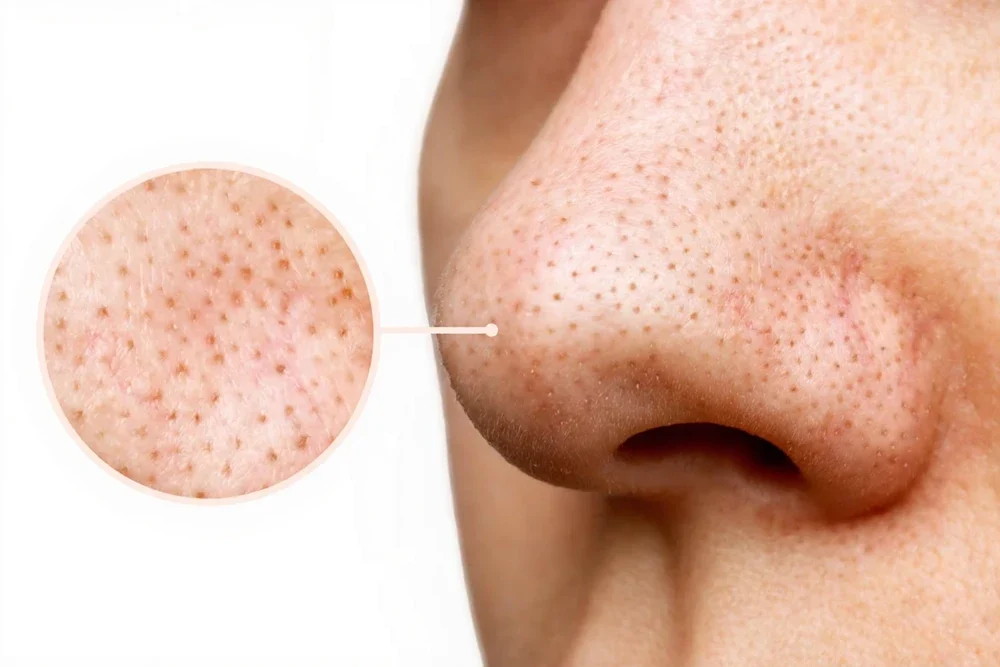
In people with oily skin, the sebaceous glands constantly produce excess sebum. As this oil tries to move out of the pore channel, it strains and dilates the channel. In addition, when the oil accumulated in the pore combines with dirt and dead skin and hardens, it physically stretches the pore walls, leading to a permanent enlargement.
Loss of Elasticity and Aging
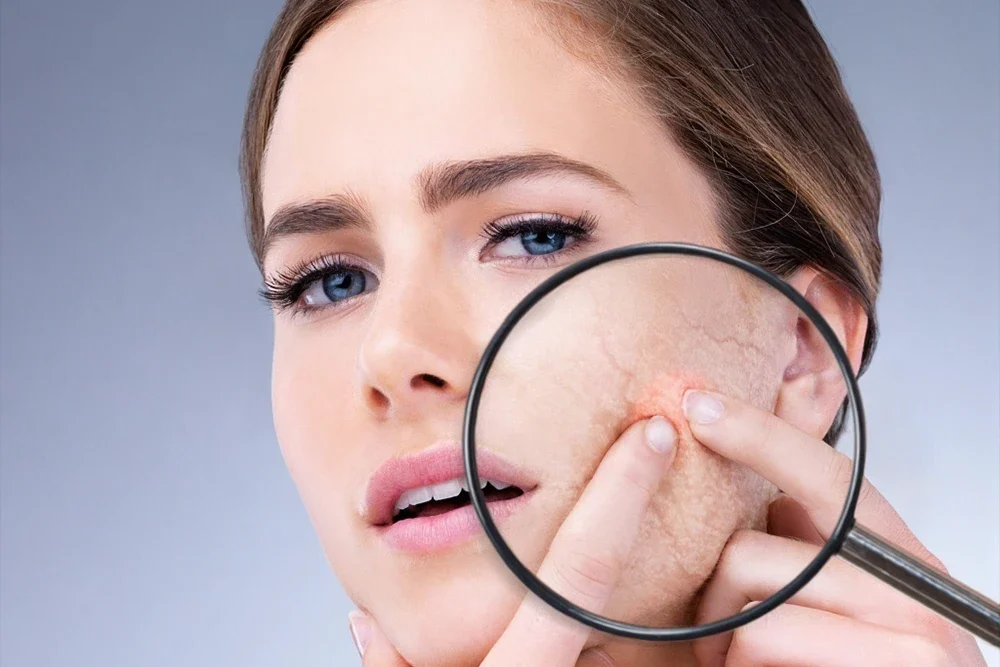
When we are young, the collagen and elastin fibers in our skin wrap around the pores like a corset, keeping them tight. When these fibers loosen with age (or sun damage), the pores lose their support and expand, sagging downward with gravity. This is the cause of the ’oval-shaped“ pores usually seen after your 30s.
Genetic Factors and Sun Damage
People with thick skin and dark skin are genetically predisposed to have larger pores. In addition, UV rays disrupt the elastic structure of the skin, causing the pore walls to collapse.
Do Pores Disappear or Shrink? Realistic Expectations
It is important to be clear: It is biologically impossible and unhealthy to completely “eliminate” pores, because the skin needs to eliminate oil and sweat. The aim of medical aesthetics is to clean and tighten enlarged and filled pores, making them so small (microscopic) that they are invisible to the eye. Our goal is not a “pore-free” skin, but a skin with “indistinct pores”.
The Most Effective Pore Tightening Technologies in Medical Aesthetics
In our clinic, we do not use a single device for pore treatment, but combined protocols according to the needs of the skin. Here are our most effective weapons:
1. Golden Needle (Scarlet X): "Ironing" the Skin from the Inside"
One of the most powerful technologies for pore tightening Scarlet X (Golden Needle) application. This system, which goes under the skin with micro-needles, works with radiofrequency heat.
The Effect of Radiofrequency on the Sebaceous Glands
Heat energy does two things: First, it tightens the pore contour by shortening relaxed collagen fibers (lifting effect). Second, and most importantly, it reduces oil production by slightly shrinking overactive sebaceous glands (sebaceous glands). When oil production decreases and the duct tightens, the pores visibly shrink.
2. Hydrafacial: Cleanse, Purify and Tighten
The emptied pore tends to shrink naturally. In addition, “Salicylic Acid” (BHA) used in the Hydrafacial protocol cleanses the pore walls, while “Glycolic Acid” applied at the end of the procedure tightens the skin. Regular Hydrafacial is the best care routine to prevent pores from refilling and enlarging.
Vacuuming of Pore Clogging Plugs
If your pores look large because they are full of oil and blackheads, the first step is cleansing. Hydrafacial, With its patented vacuum technology, it physically extracts the hardened oil inside the pores.
Let's Create Your Appointment Now
Leave your name and phone number and we will call you to discuss the right treatment and an appointment time.
Reach us by phone+90 532 336 52 003. Babyface Ultra (Thulium Laser): Resurfacing and Texture Repair
Babyface Ultra, is a laser system that improves the texture of the skin. Thulium laser beams open microscopic channels on the skin surface, triggering the skin to regenerate itself. During this regeneration, coarse skin with enlarged pores is removed and replaced by fresh skin with firmer, smoother and finer pores. It is especially ideal for those who want a “porcelain skin” effect.
4. Micro-Botox (Skin Botox): Slowing down Sweat and Oil Glands
While classical Botox is applied to the muscles, in the technique called “Micro-Botox” or “Meso-Botox”, very diluted Botox, is injected into the superficial layer of the skin. This procedure does not freeze muscles or affect facial expressions. Its target is the sweat and sebaceous glands in the skin. By temporarily slowing down the functioning of these glands, the skin becomes dull and the pores shrink. The effect lasts for an average of 3-4 months and is especially perfect for fat in the T-zone.
Why is Home Care Inadequate?
The pore tightening tonics or masks you use at home usually only create a temporary tightening on the skin surface. However, the pore problem is related to collagen loss and sebaceous gland activity in the dermis layer. Since creams cannot go to this depth, they cannot provide a structural change. Medical aesthetics offers solutions by going to the source of the problem (deep tissue). About skin pores and treatments American Academy of Dermatology (AAD) also emphasizes the effectiveness of methods such as laser and micro-needling.
How to Ensure Permanence After Treatment?
To maintain the smoothness achieved after pore treatments:
- Use sunscreen (to protect collagen).
- Choosing non-comedogenic (pore-clogging) makeup products.
- Regular skin cleansing is essential.
Personalized Pore Protocol at our Clinic in Kadikoy
Kadikoy‘At our clinic in Istanbul, we plan pore treatment as a process, not as a standard procedure. If your skin is very oily, we first establish the oil balance, and if there is a loss of elasticity, we increase collagen. By cleansing with Hydrafacial and tightening with Golden Needle or Laser, we bring your skin's “unfiltered” state to its best version.
Why Are the Nose and T-Zone the Most Common Areas?
Nearly all of my clients who come to me with concerns about pores point to the same area: the T-zone, which includes the nose, the sides of the nose, the forehead, and the jawline.
There is an anatomical explanation for this. Sebaceous glands are not evenly distributed across the face; in these areas, they are both more numerous and larger. In an area where more sebum is produced, the pore opening is naturally wider because the excretory duct has to handle a greater volume.
Do Nose Pores Close Up?
A pore is not a lid; it does not open and close. Therefore, the term “pore closure” is misleading.
What can be done is to drain the interior of the pore and reduce its appearance by supporting the surrounding tissue. For a comprehensive comparison of methods and clinical options, pore tightening I recommend that you take a look at my guide.
A Common Mistake in This Area
Trying to dry out the oily-looking area. Drying out the nose area with harsh cleansers and alcohol-based products may feel good in the short term, but the skin produces more sebum to compensate for the oil it has lost.
The result is a T-zone that’s oilier than when you started. The right approach isn’t to dry it out, but to balance it.
Frequently Asked Questions
Can pores open and close?
No. Pores do not have a muscular structure, meaning they do not open and close on their own. Their dilation is the result of structural damage.
How does excess sebum affect the skin?
As oil tries to exit the pore, it puts pressure on the pore and widens it. When the oil, dirt, and dead skin cells that accumulate inside the pore harden, they physically stretch the walls, leading to permanent enlargement.
What is the effect of aging on pores?
When we are young, collagen and elastin fibers wrap around the pores like a corset. As these fibers loosen with age or due to sun damage, the pores lose their support and sag, causing them to widen.
Do methods like using toner and ice actually work?
According to the article, the effects of these methods are generally limited to a few hours; enlarged pores are a structural problem, not a superficial one.

You may also like
-

Winter Skin Dryness: Why It Gets Worse and How to Repair It at Home
Why does skin get drier in winter, and how can you repair the skin barrier at home? Dr. Melis Ülger explains lukewarm water, ceramide creams and when to see a dermatologist. -

Why Do Sunspots Fade More Easily in Winter?
Why is spot treatment scheduled for the fall and winter? Dr. Melis Ülger explains the role of sun exposure in the process. -
Post-Summer Skin Care: Why Are September and October the Right Time?
When and in what order should you perform post-summer skincare? Learn the right methods and schedule for addressing dark spots, dryness, and skin texture, and let’s create your plan together.
 Türkçe
 English