


Before and After Dermal Fillers: Expectations and Results - A Guide to a Flawless Transformation

Highlights
- Setting realistic expectations during the decision-making process is key to the outcome.
- The rules for pre-procedure preparation and things to avoid are listed below.
- It describes what will happen in the first 24–48 hours and the final outcome two weeks later.
- The durability of the result and the timing of the next treatment are also addressed.
Before and After Dermal Fillers
However, deciding on an aesthetic procedure is only the beginning. Most of my patients worry about how they will look after the procedure, when they can return to social life or how much the procedure will hurt. 50% of a successful aesthetic result depends on the doctor's expertise, and the other 50% on how well the patient manages the process before and after the procedure. As Dr. Melis Ülger, Istanbul, Kadikoy‘In my clinic in Istanbul, I inform my patients in detail about all the stages “before the needle is inserted” and “until the result is established” in accordance with the principle of transparency. In this comprehensive guide, you will find what awaits you at every step of your dermal filler journey, what realistic expectations should be and what you need to do to achieve the perfect result.
Decision Phase: Why Dermal Fillers? Setting Realistic Expectations
Dermal fillers are usually Hyaluronic Acid (HA) based gels and their main task is to add volume. They are not a surgical facelift, meaning they do not cut away excess skin. Fillers fill under the skin, lifting it up, smoothing wrinkles and contouring. Setting your expectations correctly before the procedure prevents disappointment. Fillers do not make you “someone else”, they make you “a better, more vigorous version of yourself”.

Pre-Operation (Pre-Op): Preparation Process and Prohibitions
A perfect filling experience, ...begins days before your appointment. You should prepare your body to minimize the risk of bleeding, bruising, and swelling.
Blood Thinners and Supplements: Reducing the Risk of Bruising
A needle or cannula is used during dermal filler injection. The more watery your blood is, the greater your risk of bruising (ecchymosis) during or after the procedure. Therefore, you should consult your doctor before the procedure. 5-7 days ago it is recommended to cut out the following items:
- Painkillers such as Aspirin, Coraspin, Ibuprofen.
- Vitamin E, Omega-3 (Fish Oil), Ginkgo Biloba, St. John's Wort.
- Green tea and Ginseng.
If you are taking a prescription blood thinner, you should tell your doctor and do not stop taking it without your doctor's approval.
Alcohol and Smoking: Accelerating Recovery
Alcohol dilates blood vessels (vasodilation) and increases edema. Avoiding alcohol for 24 hours before the procedure will reduce swelling after the procedure. Smoking should be reduced for a few days before and after the procedure, if possible, as it reduces tissue healing and oxygenation.
Skin Condition Active Infection and Herpes Control
If there is an active herpes (Herpes), acne or eczema in the area to be treated (for example on the lips), the procedure is absolutely not performed. Needle insertion can spread the infection to deeper tissues. If you are a frequent cold sore sufferer, you may need to start prophylactic antiviral treatment before your lip augmentation appointment.

Procedure Sequence: What to Expect at the Clinic?
When you enter the clinic door, the process goes like this:

Pain Management: Anesthetic Creams and Comfort
The biggest fear of patients is pain. However, most modern fillers (e.g. Juvederm, Teosyal) already contain a local anesthetic called “Lidocaine”. In addition, strong anesthetic creams are applied to the application area 15-20 minutes before the procedure. Sensitive areas such as the lips are completely numb. During the procedure, there is usually a slight pressure and a sensation of a mosquito bite. There is no unbearable pain.
Injection Moment and Duration: "Lunch Break" Procedure
The filling procedure takes 15 to 30 minutes depending on the number of areas to be filled. Your physician may use the needle or blunt-tipped cannula technique in accordance with your anatomy. As soon as the procedure is finished, you can see the result in the mirror. This “instant satisfaction” is the most popular aspect of fillers.
Let's Create Your Appointment Now
Leave your name and phone number and we will call you to discuss the right treatment and an appointment time.
Reach us by phone+90 532 336 52 00Immediately After the Procedure (Post-Op): First 24-48 Hours
You look great when you leave the clinic, but you have a biological healing process ahead of you.
Edema and Swelling: The Process of "Social Recovery" and Not Panicking
Hyaluronic acid is a substance that “holds water”. When you wake up the morning after the procedure, you may notice that your face (especially your lips) is more swollen than at the time of the procedure. This is due to very normal. Don't panic. 30% of the swelling goes down in the first 3 days and the rest within 10 days. Applying an ice compress for the first 48 hours (without direct contact with the skin) reduces swelling.
Bruises and Concealer Use: When to Wear Makeup?
There may be small bruises wherever the needle enters. These bruises can usually be covered with makeup. However, in order to prevent the risk of infection, it is recommended that first 24 hours You should not apply foundation or concealer to the injection sites and keep them clean. After 24 hours, you can apply makeup as you wish. Arnica or creams containing vitamin K can be used to relieve bruising quickly.
First Night: Sleeping Position and Water Contact
Do not touch water to your face for the first 6 hours. The first night, to prevent displacement of the filling and increase edema on your back and sleeping with your head elevated (with a double pillow) is recommended. Sleeping on your stomach can cause asymmetry.

2 Weeks Later: Final Conclusion and Residency Process
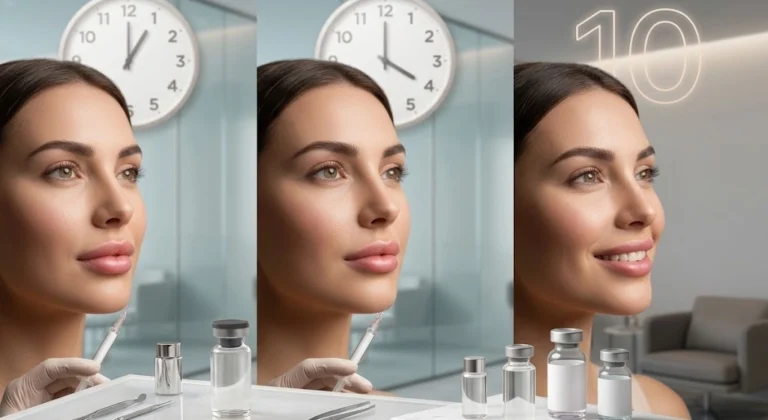
The “golden rule” for dermal fillers is 2 weeks (14 days).

Correction of Asymmetries and the Need for Retouching
Most of the asymmetries you see in the first days are actually caused by edema. One goes down, the other remains. At the end of 2 weeks, all edema is gone and the filling is integrated with the tissue. This is the real result. If there is still an asymmetry or deficiency, the “Retouching Appointment” is made on this date. Early corrections can lead to wrong results.
Integration with Texture: Feeling of Naturalness
In the first week, you may feel hardness or lumps under your skin. Over time, the hyaluronic acid spreads between the tissues, softens and becomes the same consistency as your skin. After the 2nd week, you will not feel the filler when you touch it, you will only feel your natural texture.
Permanence of Results: When Should Fillers Be Repeated?
The permanence of fillers varies according to the product used, the region and the metabolism of the person.
- Lip Fillers 6-12 months because it's a very active region.
- Under Eyes and Temples: 12-18 months because it's more sedentary.
- Cheek and Chin (Jawline): 18-24 months for hard fillings on the bone.
Regular dermal fillers trigger the skin's collagen production, thus prolonging the duration of permanence over time (cumulative effect). About the safety and permanence of dermal fillers American Food and Drug Administration (FDA) also states that products are temporary but provide long-lasting satisfaction.
Expectation vs. Reality: What Can Fillers Do and What Cannot?
Fills It volumizes, fills deep grooves, defines contours, moisturizes the skin, corrects asymmetries.
Cannot Fill It cannot tighten excessively sagging skin as much as surgery (for this you need a thread lift or surgery), does not remove skin blemishes, does not tighten pores. For skin quality mesotherapy or should be combined with laser.
Safe and Satisfaction-Oriented Process at our Clinic in Kadikoy
Kadikoy‘At our clinic in Istanbul, we manage the dermal filler process as a combination of “art and science”. Before the procedure, we analyze your face and create a plan that will give the most natural result. We use FDA-approved premium products during the procedure and closely monitor your healing process afterwards. Your satisfaction is our signature. Remember, a well-made filler does not shout “I am here”, it only makes you say “How good you look”.
Application
Filling Application
You can have this procedure done at Dr. Melis Ülger’s office in Kadıköy Caddebostan.
Frequently Asked Questions
Is a filler treatment a facelift?
No. Fillers do not remove excess skin; they lift the skin by filling the space beneath it, smooth out lines, and define the contours. They are different from surgical facelifts.
How should expectations be set?
As the article puts it, fillers don’t turn a person into "someone else"; they create "a better, more vibrant version of themselves." Setting the right expectations before the procedure helps prevent disappointment.
When do pre-procedure preparations begin?
Days before the appointment. The body needs to be prepared to reduce the risk of bleeding, bruising, and swelling.
What activities are recommended to be paused before the procedure?
After consulting your doctor, you may stop taking pain relievers such as aspirin and ibuprofen, as well as vitamin E, omega-3, ginkgo biloba, St. John’s wort, green tea, and ginseng, 5–7 days in advance. You must discuss prescription blood thinners with your doctor.
Sources

You may also like
-

How Long Does Bruising Last After Chin Filler?
Why does bruising happen after chin filler, and how many days does it take to fade? The day-by-day colour changes, ways to reduce it and warning signs. Write to us if you have questions. -

Does Lip Filler Hurt? Pain Management and the Process
Does lip filler hurt, and how much pain is there really? Read about numbing cream, lidocaine-containing products and cannulas, and book your appointment in Caddebostan. -
When Do Lip Fillers Settle? The Process, Day by Day
When do lip fillers settle in, and how many days does the swelling take to go away? Dr. Melis Ülger explains the daily timeline from the first 24 hours through the second week.
 Türkçe
 English